Predicting reversal only because volume is high, or adding contracts when the level breaks.
05 / Absorption
High effort, limited price movement
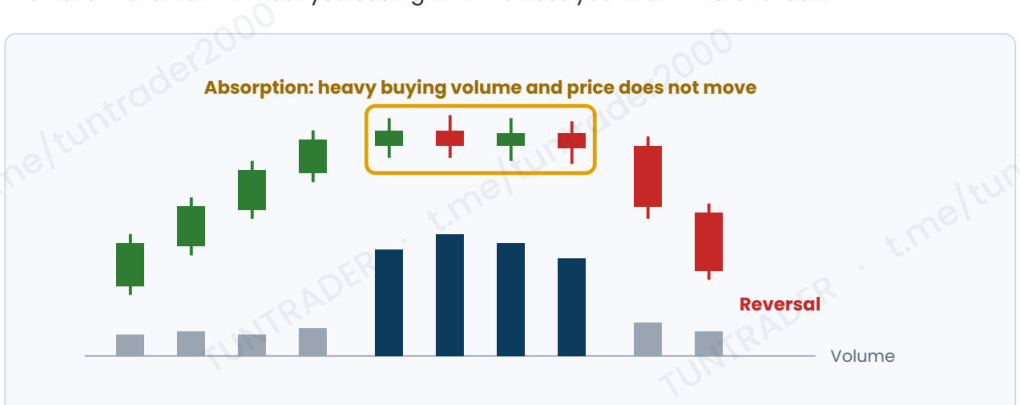
Absorption is a hypothesis: passive orders may meet strong initiative without allowing price to advance. The book studies it at a prepared level and waits for a price response.
What you need to understand
Observe before explaining
Look for a predefined level, unusual volume and limited progress despite initiative. Claiming that a bank is defending a price exceeds what these data alone identify.
Separate absorption from exhaustion
Absorption combines strong activity with limited effect. Exhaustion describes fading initiative at a move’s extreme. Either can precede reversal, but a trend can also resume.
Define when the hypothesis fails
If price breaks through and continues with volume and directional response, reassess the absorption scenario. A missing immediate reversal does not justify indefinitely widening a stop.
Worked example
Book case: near VAL 5,180, strong selling with little movement is followed by an upward response. Hypothetical entry 5,181, stop 5,176, POC target 5,200. Risk is 5 points and potential gain 19 points: 3.8 R before costs. These levels illustrate a scenario, not a current recommendation.
Separate observation, hypothesis, confirmation and invalidation. Compare behaviour with the instrument’s usual volatility.
Simulation exercise
Collect five high-volume, low-progress examples, including failures. Distinguish reversals from continuations and record what was observable before the outcome.
Source: TUNTRADER book — Wajdi Mansour, PDF file pages: 61, 62, 63, 67.
Content summarized and adapted for the site, with calculations made explicit. Examples are not current recommendations.
Open the passage in the book ↗